
Business valuation calculator
Most small service businesses sell for 2 to 4 times owner earnings (profit plus the owner's pay). Small software businesses sell for 3 to 4 times owner earnings, or about 2 times revenue.
What would a buyer pay for your agency, productized service, consultancy or software company? Answer twelve questions to get a worst case, a base case and a best case.

Valuation (estimate only)
- Worst case
- Base case
- Best case
US dollars. The sale data is from the US.
See how to raise that price
Your free report prices each fix for your business, in dollars.
- What each fix adds to your price
- The first step for each one
- What needing you costs at a sale
Your report is below.
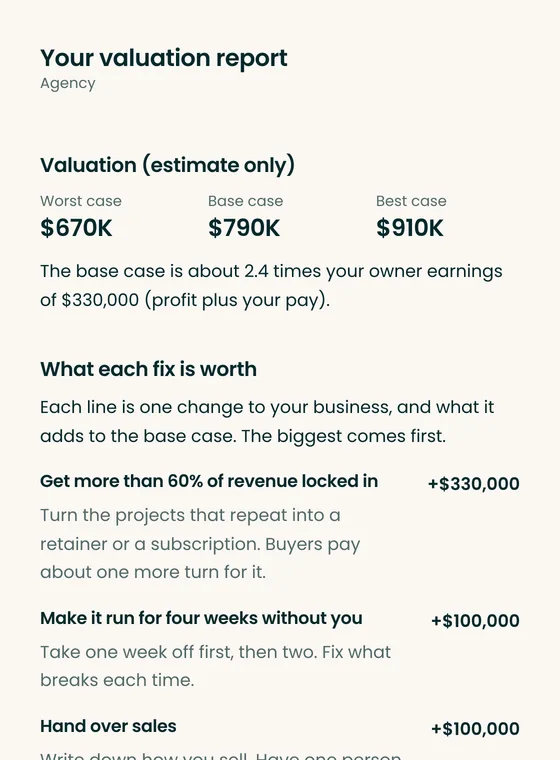
Your valuation report
Valuation (estimate only)
- Worst case
- Base case
- Best case
What each fix is worth
-
Make it run for four weeks without you
Take one week off first, then two. Fix what breaks each time.
-
Hand over sales
Write down how you sell. Have one person run it beside you until they close without you.
-
Give your biggest clients someone else to call
Name an account lead for each big client. Bring them to every call until the client rings them first.
-
Hand day-to-day decisions to your managers
List the decisions that reach you in a week. Hand off the small, frequent ones first, with a spending limit.
-
Write down how you do things
Record yourself doing each job once. Have the next person write the steps and run the job from them.
-
Get more than 60% of revenue locked in
Turn the projects that repeat into a retainer or a subscription. Buyers pay about one more turn for it.
-
Get churn under 2% a month
Find out why customers leave in their first 90 days. Fix that before anything else.
-
Get your biggest client under 15% of revenue
Win two or three mid-size clients before you sell. Don't shrink the big one.
-
Grow revenue 10% or more a year
Buyers pay for a trend they can extend. Twelve steady months count for more than one big quarter.
What needing you costs
How you'd be paid
Your answers
- Kind of business
- Revenue
- What you paid yourself
- Profit before tax
- How did revenue go in the last 12 months?
- How much of your revenue is locked in? (Retainers, subscriptions, contracts.)
- How many customers churn each month?
- How much of your revenue comes from your biggest client?
- You take four weeks off. No phone, no laptop. What happens?
- Who brings in the new clients?
- Something goes wrong. Who do your biggest clients call?
- Who makes the day-to-day decisions?
- Is how you do things written down, so someone else can do it?
How this estimate is made
Your profit plus your pay gives your owner earnings. A buyer pays a multiple of that. The multiple comes from published sale prices for businesses of your type and size, and it moves with your answers. This is an estimate, not a formal valuation. Get advice from a broker or an M&A adviser before you sign anything.
Next step
Want help with the first fix? That's the work I do with founders. Book a free 25-minute call and bring this report. cal.com/claff/25-min
Alex McClafferty, founder coach. productize.co
How the calculator works
I sold WP Curve to GoDaddy, and I've helped clients on both the buy side and the sell side. Every buyer I've seen does the same sum, in four steps.
- Owner earnings. Your profit before tax plus what you paid yourself. Brokers call it SDE, seller's discretionary earnings. It is what the business gives one owner in a year.
- A starting multiple. What businesses of your type and size sell for, as a multiple of those earnings. Bigger businesses get a higher multiple. Once a business earns more than $500,000 after paying a manager $150,000 to do your job, buyers price it on that profit instead. Brokers call that one adjusted EBITDA.
- The things a buyer checks. Growth, recurring income, your largest client and how much the business needs you. Each one moves the multiple up or down.
- Three cases. Two buyers never offer the same price. The base case is the middle figure. The worst case is 15% under it, and the best case is 15% over it.
Every figure is in US dollars, and the sale data is from the US. The full method is below.
Worked examples
What a buyer might pay for eight businesses. Each one has flat revenue, some of it locked in, no big client, and a founder who is partly needed.
| Business, revenue and owner earnings | What a buyer might pay |
|---|---|
| Agency, $500K revenue, $150K owner earnings | $280K to $380K |
| Agency, $1M revenue, $300K owner earnings | $700K to $950K |
| Agency, $3M revenue, $900K owner earnings | $2.7M to $3.65M |
| Productized service, $1M revenue, $300K owner earnings | $840K to $1.14M |
| Consultancy, $1M revenue, $300K owner earnings | $560K to $760K |
| Software or SaaS, $500K revenue, $150K owner earnings | $770K to $1.03M |
| Software or SaaS, $2M revenue, $400K owner earnings | $4.8M to $6.5M |
| Software or SaaS, $5M revenue, $750K owner earnings | $15.4M to $20.8M |
What moves the price
How much does one big client cut the price?
Take an agency with $1 million in revenue and $300,000 in owner earnings. With no client above 15% of revenue, the base case is $830K. With a client at 15% to 25%, it is $750K. With a client above 25%, it is $600K. That is 0.25 and 0.75 turns off the multiple. The buyer also holds more of the price back, because that client can leave.
How much does recurring revenue add to the price?
For the same business, the base case is $680K with less than 30% of revenue locked in, $830K with 30% to 60%, and $1.13M with more than 60%. Locked in means retainers, subscriptions and contracts. FE International reports that agencies with more than 60% retainer income sell for one to two turns more than project shops.
How much does growth add to the price?
For the same business, the base case is $680K if revenue dropped in the last 12 months, $830K if it was flat, $900K if it grew 10% to 30%, and $980K above 30%. Buyers pay for a trend they can extend.
How much does founder dependence cut the price?
For the same business, the base case is $1.05M when it runs without its founder and $600K when it needs the founder for everything. Value Builder's data on 80,000 owners points the same way: the average business gets offers of 3.5 times pre-tax profit, and the best-run ones get 7.1 times.
How much of the price does a buyer hold back?
When the founder does the selling, or one client is more than 25% of revenue, cash on the day can drop to about 50% of the price. Another 25% to 40% can come later as an earn-out, if the business performs. Those are FE International's figures for agencies.
How much does churn cut the price of a software business?
For the same business, the base case is $2.5M when less than 2% of customers churn each month, $2.2M at 2% to 5%, and $1.73M above 5%. A buyer reads churn as how long the revenue will last.
What I saw in real deals
- WP Curve started in 2013, passed seven figures in annual revenue and sold to GoDaddy in 2016. I took 32 people across with me.
- A founder I advised had one marquee customer. Between the term sheet and due diligence, the buyer tied performance targets and clawbacks to that one account. A big client doesn't only cut the multiple. It rewrites the terms.
- An earn-out ties your payout to things the buyer controls after the sale. A re-org or a new strategy can wash it away.
The full stories are in What they don't tell you about selling your startup.
Questions founders ask
How much is a business worth with $1 million in sales?
Sales alone don't set the price. Buyers pay for profit. An agency with $1 million in sales and $200,000 in owner earnings sells for about $410K to $550K. The same sales with $400,000 in owner earnings sells for about $1.02M to $1.38M. Owner earnings are your profit plus what you paid yourself.
How much is a business worth that makes $300,000 a year?
If the $300,000 is profit plus your own pay, a typical agency sells for about $700K to $950K. That is 2.8 times owner earnings. Steady contracts and a team that runs things push it up. One big client or a founder who does everything pushes it down.
Is a business worth 3 times profit?
Often, for a small one. In BizBuySell's report for the third quarter of 2026, the median small business sold for $350,000 on $156,000 of cash flow. That is about 2.2 times. FE International puts agencies with less than $500,000 in earnings at 2.5 to 4 times. Bigger businesses get more: 4 to 6.5 times profit for an agency that earns $1 million to $2.5 million.
How do I work out what my business is worth?
Add your profit before tax to what you paid yourself. That is your owner earnings. Multiply it by what businesses like yours sell for, usually 2 to 4 times for a small service business. Then adjust for growth, recurring income, your largest client and how much the business needs you. The calculator on this page does those steps for you.
Why does a business that needs its founder sell for less?
A buyer is paying for profit that keeps coming after you leave. If you bring in the clients and make the decisions, that profit can leave with you. So the buyer offers a lower multiple, pays more of the price later as an earn-out, or asks you to stay for years. Value Builder's data on 80,000 owners shows the size of the gap: the average business gets offers of 3.5 times pre-tax profit, and the ones that score 90 or more get 7.1 times.
Is this a formal valuation?
No. It is an estimate from published sale prices, good for planning and for a first sanity check on an offer. A real buyer looks at your contracts, your team, your books and the market that month. Before you sign anything, get advice from a broker or an M&A adviser.
The full method
Here is every step and every number, so you can check the sum by hand. An AI assistant can do the same from this page. The figures are dated 13 November 2026. I check them against the sources each quarter, next in February 2027.
- Owner earnings. Add the profit before tax to what the owner was paid, both for the last 12 months. Brokers call this SDE (seller's discretionary earnings). All figures are US dollars. The sale data is from the US.
- The figure to price on, for a service business (agency, productized service or consultancy). Take $150,000 off the owner earnings. That is the pay of a manager who does the owner's job, and what is left is the adjusted EBITDA. If it is under $500,000, price on owner earnings. If it is $500,000 or more, price both ways and keep the higher price.
- The figure to price on, for software. Price on owner earnings and on revenue. Keep the higher price.
- The starting multiple. Read it from the table for that figure. Between two rows, draw a straight line on a log scale of the dollar figure: multiple = m0 + (m1 - m0) x (ln x - ln x0) / (ln x1 - ln x0). Under the first row, use the first multiple. Over the last row, use the last multiple.
- The type weight, for a service business. Multiply the starting multiple by 1.2 for a productized service, 1 for an agency and 0.8 for a consultancy. Software has no weight.
- The answers. Each answer moves the multiple by a number of turns (a turn is one times earnings). Add the moves from the table of answers and the founder score. For a service business, multiply each move by the type weight. For software priced on revenue, multiply each move by the starting multiple divided by 3.5.
- The multiple. Add the moves to the starting multiple. It never goes under 1 (or 0.5 for a multiple of revenue).
- Three cases. The base case is the multiple times the figure. The worst case is 15% under it, and the best case is 15% over it.
- Rounding. Round each case: under $20,000 to the nearest $1,000, under $200,000 to the nearest $5,000, under $2,000,000 to the nearest $10,000, under $10,000,000 to the nearest $50,000, $10,000,000 or more to the nearest $100,000.
The starting multiples
| Service business, priced on owner earnings (SDE) | Multiple |
|---|---|
| $50,000 | 1.8 |
| $156,000 | 2.2 |
| $400,000 | 3 |
| $650,000 | 3.2 |
2.2 times at $156,000 is BizBuySell's median. The higher points follow FE International's range for agencies with less than $500,000 in earnings. The first point is my estimate.
| Service business, priced on profit after a manager's pay (adjusted EBITDA) | Multiple |
|---|---|
| $500,000 | 4.1 |
| $900,000 | 4.3 |
| $1,600,000 | 5.25 |
| $3,500,000 | 7 |
| $8,000,000 | 9.5 |
The middle of FE International's bands for agencies by size.
| Software, priced on owner earnings (SDE) | Multiple |
|---|---|
| $50,000 | 2.7 |
| $150,000 | 3.4 |
| $400,000 | 3.9 |
| $850,000 | 4.5 |
| $3,000,000 | 6 |
3.4 times is the figure from 651 small software listings. 3.9 times is the median of Acquire.com's closed deals. The first and the last two points are my estimates.
| Software, priced on revenue | Multiple |
|---|---|
| $100,000 | 1.5 |
| $500,000 | 1.8 |
| $1,000,000 | 2.2 |
| $3,000,000 | 3.2 |
| $10,000,000 | 4.2 |
| $30,000,000 | 4.8 |
About 2 times revenue for small listings is from the same 651 listings. The points above $1 million are my estimates from what larger private software companies sell for.
The type weights are my own judgement, not a published figure.
The score for every answer
| Answer | Move to the multiple |
|---|---|
| Revenue in the last 12 months | |
| It dropped | -0.5 turns |
| Flat, or up less than 10% | No change |
| Up 10% to 30% | +0.25 turns |
| Up more than 30% | +0.5 turns |
| Revenue that is locked in (service businesses only) | |
| Less than 30% | -0.5 turns |
| 30% to 60% | No change |
| More than 60% | +1 turn |
| Customers who churn each month (software only) | |
| Less than 2% | +0.5 turns |
| 2% to 5% | No change |
| More than 5% | -0.75 turns |
| Revenue from the biggest client | |
| Less than 15% | No change |
| 15% to 25% | -0.25 turns |
| More than 25% | -0.75 turns |
Each of the five founder questions scores 0, 1 or 2 points: 0 for the first answer, 1 for the second, 2 for the third. Add the points. The move is 0.75 minus 0.15 for each point, so it runs from +0.75 turns (0 points, the business runs without its founder) to -0.75 turns (10 points, it needs the founder for everything).
The locked-in revenue figure is FE International's: agencies with more than 60% retainer income sell for one to two turns more than project shops. The other moves are my estimates, the founder figure included.
One business, step by step
An agency with $1,200,000 in revenue, $180,000 in profit and $150,000 in owner's pay. Revenue is up 10% to 30%, 30% to 60% of it is locked in, the biggest client is 15% to 25% of revenue, and the founder questions score 8 points.
- Owner earnings: $180,000 profit + $150,000 owner's pay = $330,000.
- Adjusted EBITDA: $330,000 - $150,000 = $180,000. That is under $500,000, so the price is on owner earnings.
- Starting multiple: $330,000 is between $156,000 (2.2) and $400,000 (3). 2.2 + (3 - 2.2) x ln(330000 / 156000) / ln(400000 / 156000) = 2.2 + 0.8 x 0.796 = 2.84.
- Type weight (agency): 2.84 x 1 = 2.84.
- Answers: Growth +0.25, Locked-in revenue 0, Biggest client -0.25, Founder score (8 points) -0.45. Total -0.45 turns.
- Multiple: 2.84 - 0.45 = 2.39.
- Base case: $330,000 x 2.3866 (the multiple before rounding) = $787,564, rounded to $790,000.
- Worst case: 15% under, $670,000. Best case: 15% over, $910,000.
The figures as a data file
The data file holds every table on this page, with the date and a change log. Free to quote, with a link back to this page.
- 2026-11-13: First version. Service multiples from FE International (2026) and BizBuySell (third quarter of 2026). Software multiples from State of Small SaaS Valuations 2026 and Acquire.com's closed deals.
Use it from ChatGPT or Claude
An assistant that drives a browser can fill in the form above. An assistant that only reads pages can get the answer at a web address. Give it your numbers and this address, and it gets the three cases back as text.
https://productize.co/api/valuation?type=agency&revenue=1200000&profit=180000&owner_pay=150000&growth=up&recurring=mid&top_client=mid&founder=22121
The address by itself lists every option. For tools, there is an OpenAPI file, a connector for Claude and ChatGPT (an MCP server, no sign-in), a Markdown copy of this page and a short guide to this site.
Put the calculator on your site
Copy this code into your page. It shows the questions and the three cases.
<iframe src="https://productize.co/business-valuation-calculator/embed/" title="Business valuation calculator" width="100%" height="1700" style="border:0" loading="lazy"></iframe>
<p>Calculator by <a href="https://productize.co/business-valuation-calculator/">Alex McClafferty, productize.co</a></p>
Sources
- FE International, Agency valuation multiples in 2026: multiples by size of agency, and what retainers and client concentration do to them.
- BizBuySell Insight Report: sale prices and cash flow for small businesses sold in the US, by quarter.
- State of Small SaaS Valuations 2026: multiples of sales and profit from 651 small software listings, and Acquire.com's closed deals.
- Value Builder System, The Owner's Metric: offers received by 80,000 owners, by Value Builder Score.
Selling soon? Read what they don't tell you about selling your startup and the 105 due diligence questions a buyer will ask.